
Getting to Rougemont
Rougemont is a magnificent mountain village situated in the heart of the Prealps (Canton of Vaud) between Château-d’Oex and Gstaad. Its privileged location offers a wide range of cultural and sporty activities throughout the year.
Access
By car
- From Geneva/Lausanne: expressway A1/A9 to Vevey, then A12 to Bulle followed by the cantonal road to Rougemont (ca. 40 min., direction Château-d’Oex – Saanen).
- From Valais/Chablais: from Aigle via Col des Mosses to Château-d’Oex (ca. 40 min.), then cantonal road to Rougemont
- From Zurich/Berne/Fribourg: expressway A1/A12 to Bulle, then cantonal road to Rougemont (ca. 40 min., direction Château-d’Oex – Saanen).
By train
- From Genève/Lausanne: CFF to Montreux – MOB to Rougemont (ca. 70 min., direction Zweisimmen).
- From Zurich/Berne: CFF to Spiez – BLS to Zweisimmen – MOB to Rougemont (ca. 30 min. direction Montreux).
- Timetables available at www.cff.ch
Setting in Rougemont
Accommodation
Two rental agencies and the direct reservation service of Pays-d’Enhaut Tourisme are at your disposal if you wish to rent an appartment for the four days of the festival.
CF Immobilier
Rue du Village 40
1659 Rougemont
T +41 26 925 1000
www.cfimmobilier.ch
Immoflor
Centrale de réservation
Activities
The Office of Tourism in Rougemont is glad to answer your questions and assist in organizing your stay. Information is available at www.chateau-doex.ch
Office du Tourisme
Case postale
CH-1659 Rougemont (Suisse)
T +41 26 925 11 66
E contact[at]festival-la-folia.ch
Saint Nicolas Church
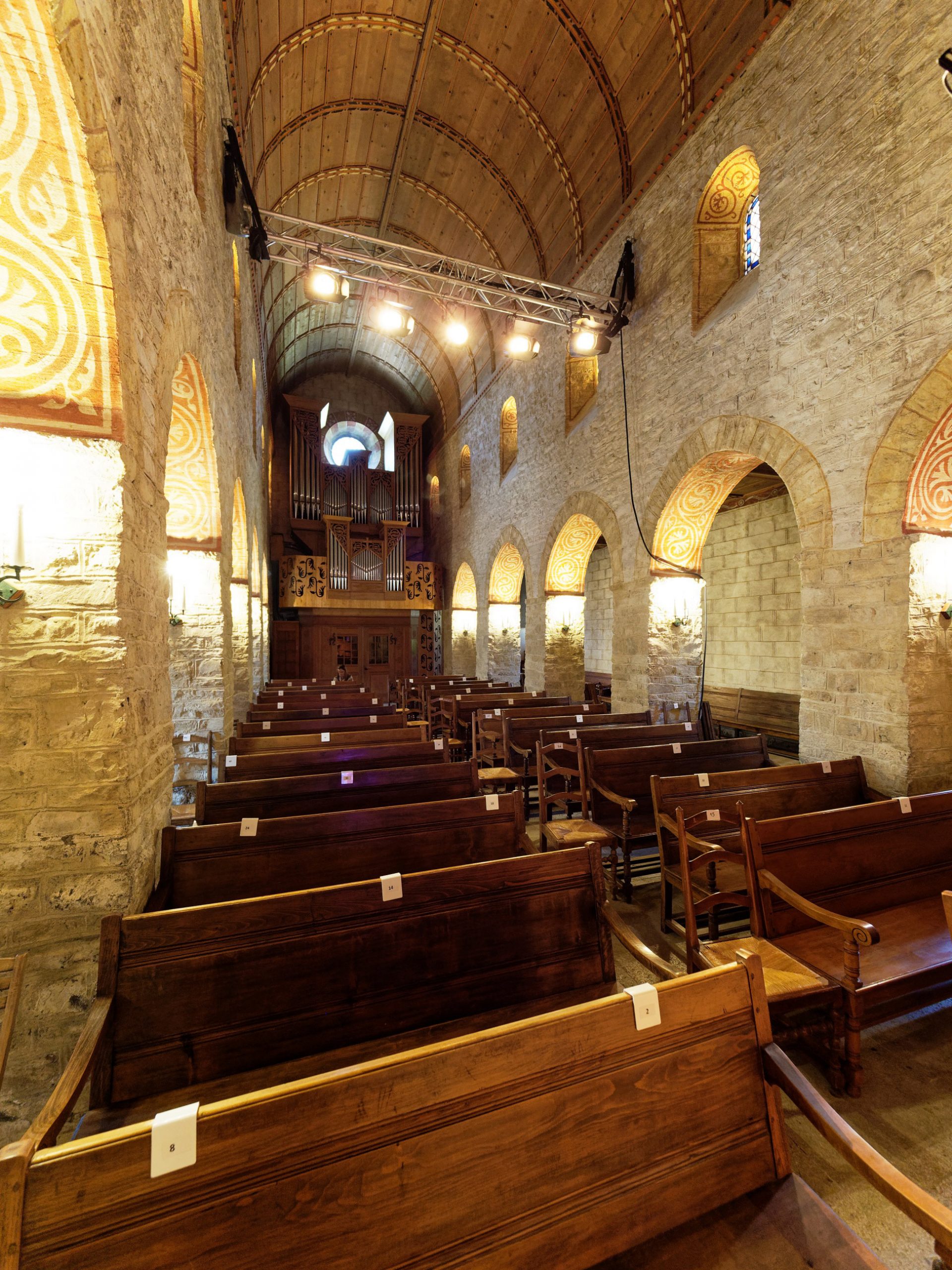
All the Festival concerts take place in the unique setting of the Church Saint-Nicolas in Rougemont which is the keystone to the event – its starting point, its reason for being – and for the artists it is a source of inspiration.
The church was built around the year 1080 by monks of Cluny who had been mandated by the Count of Gruyère to build a monastery. This priory is the first and only convent in the Prealps in the Canton of Vaud. Rougemont thus belongs to the same spiritual family as the abbeys of Payerne and Romainmôtier. The sanctuary is dedicated to Saint Nicolas de Myre, a martyr from the 4th century and patron of children whose feast day is 6th of December. The church has not been subject to any significant alterations except for the choir, transept and bell tower. it is Romanesque in style, built after the classic Cluny model. It has the form of a Latin cross; the tall nave is supported by side aisles. The choir has three apses; there is a square bell tower at the cross of the transept. Certain modifications were made to the plan, particularly during the Bernese period. The transept was shortened, the chevet was enlarged. A unique roof, very steep, replaced the roofs covering the nave and the side aisles. The bell tower’s Romanesque roof was replaced by a pointed roof in the Bernese [Oberland] style.
The Bernese period saw other changes. The reformation was preached in Rougemont as of 1555, the church becoming reformed. As for the priory, it was destroyed and replaced by the castle of the bailiffs. The inscribed gravestones in the church are for members of the Bernese family of bailiffs. A major restoration from 1919 to 1926 brought to light the edifice’s stone structure which was previously hidden by 5 layers of plaster. The nave’s ceiling was rebuilt with wood vaults. The paintings were made by Correvon after motives of the 13th century. The center stained glass window (Rivier) is dedicated to Christ; the two side stained glass windows (Delachaux) recall the donation of Rougemont to the monks of Cluny and the preaching of the reformation. The bell tower houses four bells: three date from the 15th century, the fourth was made for the 900th anniversary of Rougemont in 1980.
The Great Organ was replaced by an entirely new instrument in 2018.
Various links
The Festival team encourages you to discover the following links: